

By R.L. Bynum
There are a lot of unknowns about UNC’s opener Monday night, but you can be sure about the TCU offense: It’s built to stretch the field horizontally and vertically, forcing the Tar Heels to defend every blade on the natural grass that has returned to Kenan Stadium.
Under Coach Sonny Dykes, the Horned Frogs lean on a fast tempo. This identity remains even after the wide receiver room underwent a turnover around record-setting quarterback Josh Hoover.
“They make you defend all the blades of grass,” Belichick said, noting TCU’s ability to hit on go routes, slants and screens. “Sideline to sideline, the line of scrimmage to 50 yards downfield.”

With a strong throwing arm and comfort in Dykes’ system, Hoover is the trigger man for an attack that uses run-pass options (RPOs) and thrives on rhythm but isn’t afraid to take vertical shots with five eligible receivers on each play.
“[They] do a good job of putting stress on the defense,” Belichick said. “This is one of those games where, defensively, everybody will have to really do a good job with their responsibility.”
Expect TCU to pair their tempo passing with enough zone, run-pass options and bubble screens to keep UNC’s defensive front honest, then attempt big plays when the Tar Heels’ secondary pushes forward.
Hoover, a 6–2, 200-pound redshirt junior on the watch list for five national awards, threw for 27 touchdowns and a program-record 3,949 yards in his second season as a starter, putting him 204 yards shy of the top five on the program’s career passing list.
“The number of explosive plays they get is impressive,” Belichick said. “When the receivers get the ball in their hands, they’re very good after the catch.”
While most of his passing targets have changed, Dykes likes the continuity of Hoover being back.
“There’s a little bit of certainty as far as what’s going to happen,” Dykes said.
Gone to the NFL are three veteran receivers who combined for more than 5,400 career yards: Jack Bech (Los Angeles Raiders), Savion Williams (Green Bay Packers) and JP Richardson (Chicago Bears).
That leaves a revamped receiving corps to match last season’s production in a pass-first scheme. The Frogs dipped heavily into development and the transfer portal to reload, and Monday will be the first look at how well the pieces fit.
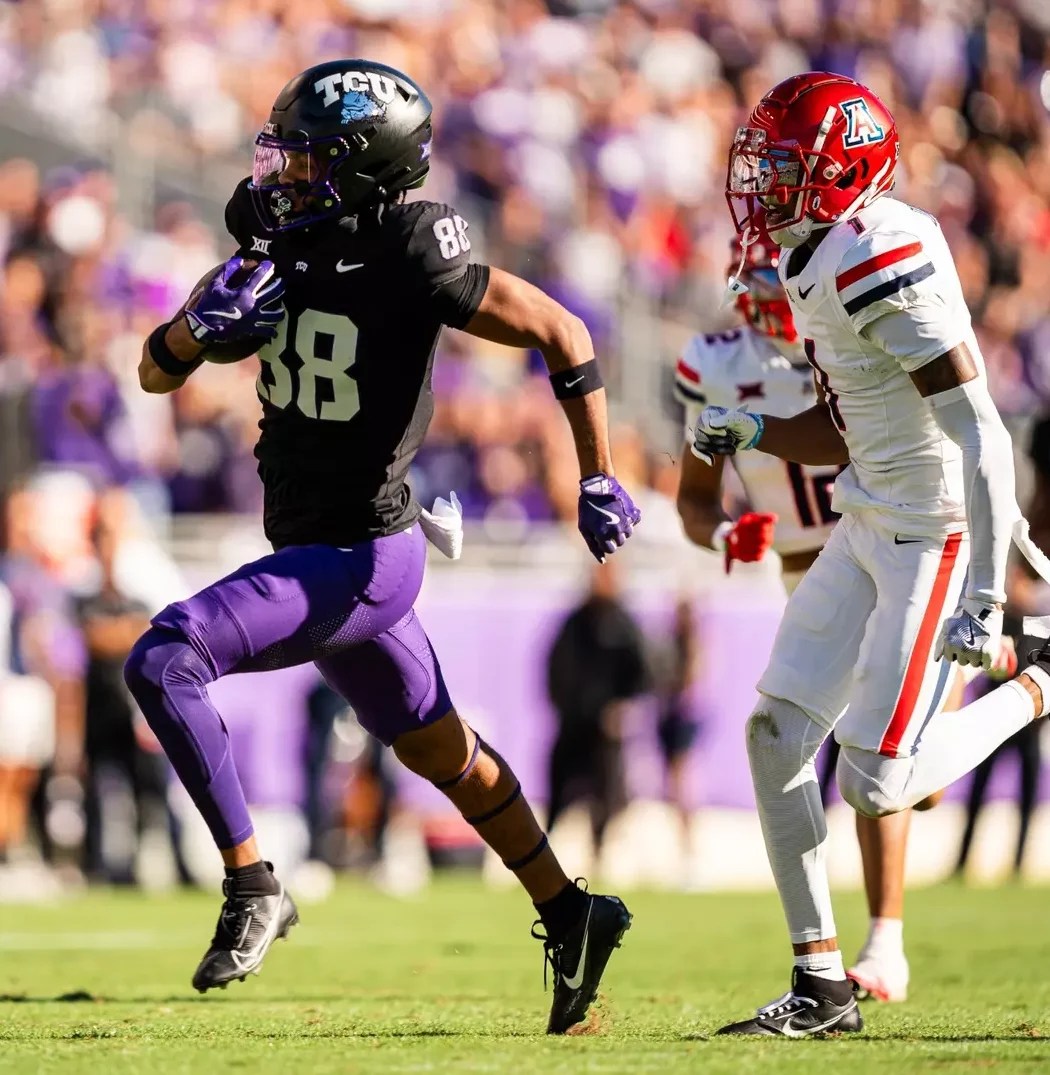
The only returning wide receiver is Eric McAlister (top photo), a former Boise State player who had 39 catches for 762 yards and five touchdowns last season, his first with the Frogs.
Houston transfer Joseph Manjack IV, who began his career at USC, is expected to get his share of catches. He caught 22 passes for 351 yards and three touchdowns last season for the Cougars.
A missing element last season to balance the potent passing attack was a decent ground game, with TCU averaging only 113.9 rushing yards per game, its lowest total since 1997.
With TCU’s starting running back and leading rusher from last season, Cam Cook, transferring to Jacksonville State, sophomore Jeremy Payne may get the biggest rushing load. His totals of 246 yards and three touchdowns led the returnees. Also in the mix is redshirt senior Trent Battle, who collected 192 yards on 44 carries.
TCU’s offensive coordinator is Kendal Briles, who was Baylor’s offensive coordinator when the Bears ran for 645 yards and piled up 756 total yards in a 49–38 bowl win in 2015 over Carolina in Orlando, Fla. (then known as the Russell Athletic Bowl, now known as the Pop-Tarts Bowl). So, if TCU finds consistent success like that on the ground Monday, the Frogs will likely exploit that.
For UNC, containing TCU means more than stopping Hoover’s arm. It’s about handling tempo, tackling when receivers have space in the open field, and staying disciplined against a scheme built to create mismatches.
Photos via gofrogs.com

 tarheeltribune.com