

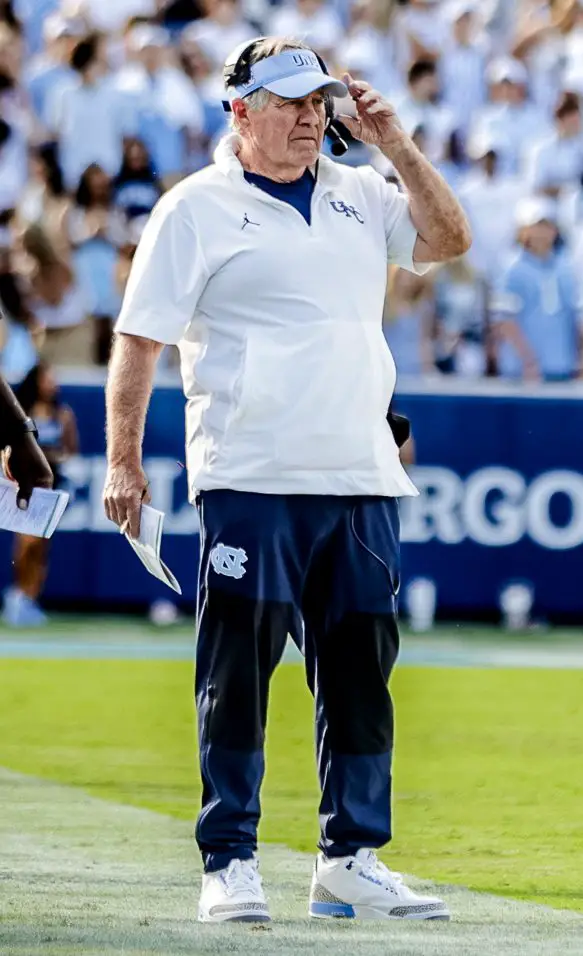
By R.L. Bynum
CHAPEL HILL — How do coaches deal with a quarterback who is new to the program but has been inconsistent while starting the first three games?
In the case of Bill Belichick and junior South Alabama transfer Gio Lopez at Carolina, the veteran coach spoke about it the way a professor might lecture, drawing on decades of experience with stars like Tom Brady and other quarterbacks of varying talent.
He didn’t start with big-picture philosophy. He went straight into the details of timing, spacing and the half-second windows where games are won or lost.
“The timing really comes from two people,” Belichick said Tuesday ahead of his 2–1 Tar Heels 3:30 game Saturday at 2–0 Central Florida (Fox). “The person throwing and the person catching. But then also the distribution of the players around them.”
He didn’t make it sound complicated, but it was clear that this could make the difference between winning and losing.
Belichick described what happens when the receiver is a half-second off. If he is too early, too late, and suddenly the quarterback is forced to adjust, move in the pocket, find a lane, or risk the play collapsing, a drive stalls.
“Those little things can be the difference between a big play and an interception,” he said. “There’s no magic wand to it. It’s just doing it over and over and having that confidence where you can. As a quarterback, let the ball go just a split-second early because you know the receiver’s going to be there.”
That repetition showed up last Saturday, including when Lopez found wide receiver Jordan Shipp on a first-quarter corner route for a 29-yard touchdown pass.
“When the ball comes out on time, there’s confidence,” Belichick said. “If you hesitate another split second, maybe he makes the catch, maybe he doesn’t get that extra two yards for the first down. There’s a difference between anticipating the receiver being open and then seeing him open and then throwing the ball. A lot of times it’s too late.”
For Belichick, the process is personal. Coaching quarterbacks isn’t about installing a generic system. It’s about figuring out what each one needs to become better and drilling it until it shows up in games.
“You try to find the ones that you feel like are most important for that particular player,” he said. “There are some things he’s really good at, other things he’s OK at, and some things he needs to improve on.
“You try to help the player with whatever it is that you feel like will help him the most, or the most important things for him,” he said. “It’s not the same with every player. We all learn differently. We all process differently. And coaching quarterbacks is very much a one-on-one proposition. They may learn differently as well, or have different strengths and weaknesses. So, you have to adapt it; it’s very individualized. Each guy is different.”
When Brady was still a young quarterback, Belichick remembered how much time they spent in the meeting room dissecting coverages, not just to recognize them but to anticipate them before the snap. Brady, he said, learned to understand the weak spots of a defense, where the ball needed to go before the defenders even rotated.
“With Tom, he wasn’t going to run a lot, so it was about understanding coverages,” Belichick said. “Understanding the weak spots of the defense and playing situational football.”
That was the NFL. College football, Belichick pointed out, brings different elements but the same core principles, so the approach isn’t that different.
“You don’t want to overload them,” he said. “You want to find something that they can tangibly grab a hold of and say, “OK, yeah, that makes sense. That helps me.”
Above all, Belichick made it clear that the connection between coach and quarterback is about trust. Every play is a test of whether they’re seeing the same thing at the same time.
“When it comes down to a critical situation, I want to make sure that what I want for the team is the same thing the quarterback is trying to do,” he said. “You just don’t want to come off after a play and say, ‘I thought we were trying to do this, and now we’re trying to do that.’ ”
Belichick didn’t romanticize the process. He discussed ball security, huddle communication, and other non-negotiables. Get those right, he said, or nothing else matters.
“Not groundbreaking news,” he said. “But if you do those things wrong, your chances of being a good player are pretty low.”
It’s that mix of repetition, trust, and situational work that defines his approach.
Because to Belichick, the difference between a winning throw and a costly mistake isn’t luck. It’s a quarterback who has been taught to make the right decision in the smallest possible window, over and over, until it’s automatic.
At North Carolina, he hopes that guy is Lopez as he continues to improve.


| Month/ date | Score/ time | Opponent | Record/ TV |
|---|---|---|---|
| September | |||
| 1 | L, 48–14 | vs. TCU | 0–1 |
| 6 | W, 20–3 | at Charlotte | 1–1 |
| 13 | W, 41–6 | vs. Richmond | 2–1 |
| 20 | L, 34–9 | at UCF | 2–2 |
| October | |||
| 4 | L, 38–10 | vs. Clemson | 2–3, 0–1 ACC |
| 17 (Fri.) | L, 21–18 | at California | 2–4, 0–2 |
| 25 | L, 17–16, OT | vs. No. 16 Virginia | 2–5, 0–3 |
| 31 (Fri.) | W, 27–10 | at Syracuse | 3–5, 1–3 |
| November | |||
| 8 | W, 20–15 | vs. Stanford | 4–5, 2–3 |
| 15 | L, 28–12 | at Wake Forest | 4–6, 2–4 |
| 22 | L, 32–25 | vs. Duke | 4–7, 2–5 |
| 29 | L, 42–19 | at N.C. State | 4–8, 2–6 |
Photo by Joshua Lawton

 tarheeltribune.com