

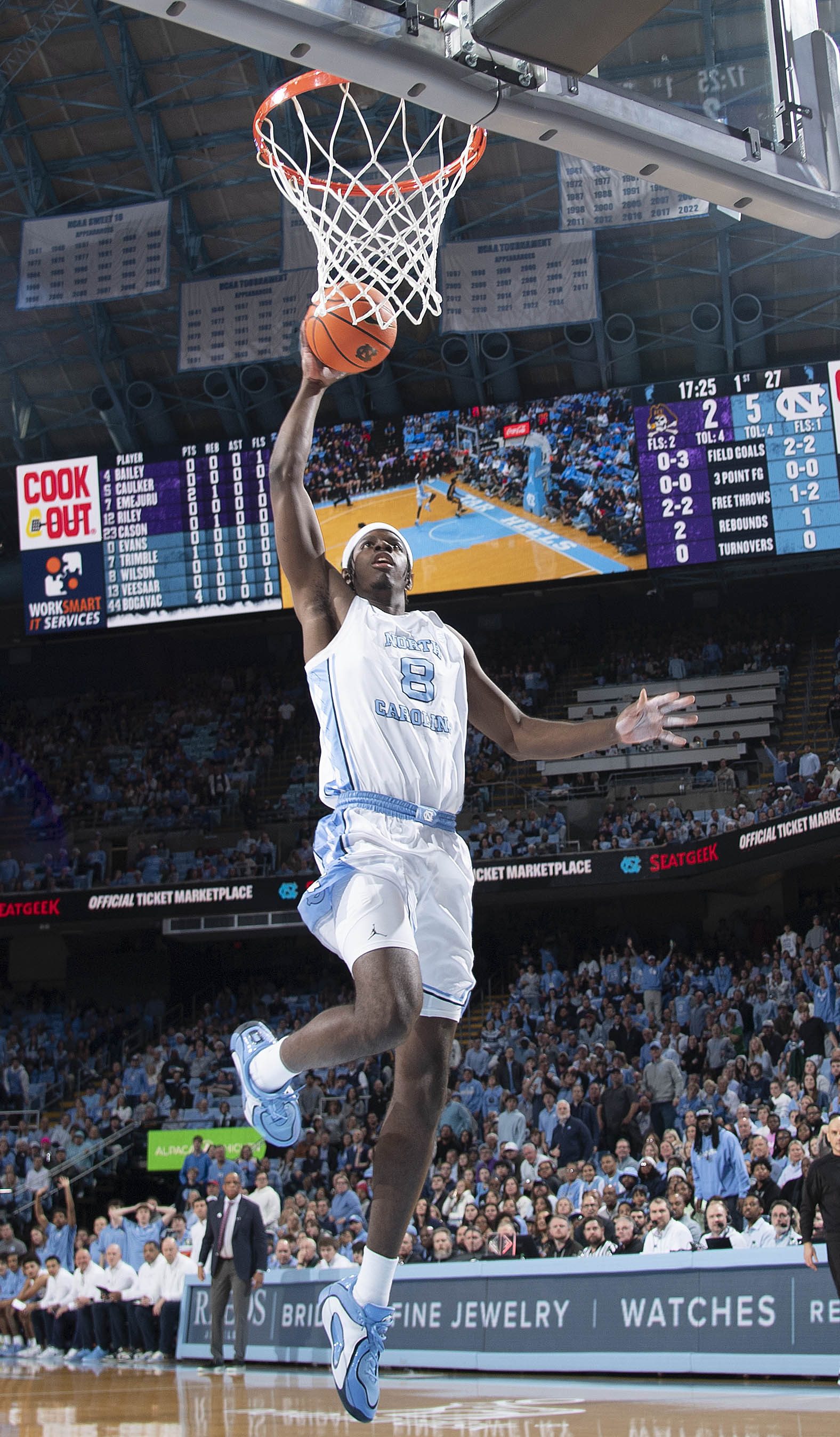
By R.L. Bynum
Any discussion about the best freshman seasons in Carolina basketball history includes Phil Ford, Antawn Jamison, Tyler Hansbrough, Armando Bacot, among others. Caleb Wilson has taken only 13 games to play his way into that chat.
Wilson’s numbers aren’t just good; they’re making history. He’s averaging a team-high 19.6 points and an ACC-high 10.8 rebounds on 55.4% shooting (7th in the ACC), with 1.54 blocks (fifth in the ACC) and 1½ steals per game.
That production that has already yielded nine double-doubles, tying Sam Perkins (1980–81) and J.R. Reid (1985–86) for third-most by a Tar Heel freshman, closing in on the totals of Bacot (11, 2019–20) and Jamison (13, 1995–96).
His Monday demolition of East Carolina, with 21 points, 12 rebounds, four blocks and three steals in 24 minutes, did more than pad a box score. It marked five consecutive 20-point games, matching the 50-year-old record for a UNC freshman, which only Ford (1974–75) previously reached.
Wilson’s nine 20-point games as a freshman trail only Ford (10), Rashad McCants (12 in 2002–03) and Hansbrough (14 in 2005–06).
When history is made so early, it usually means the player isn’t just collecting numbers. He’s creating a team’s identity. Wilson’s fingerprints are there, unmistakable, all over No. 12 UNC’s 12–1 start, in the ways Coach Hubert Davis keeps describing him.
— In September, Davis labeled him “uber‑talented and selfless,” emphasizing how Wilson talks about the team and North Carolina more than himself.
— In December, Davis has zeroed in on processing: “When they put two on the ball, he becomes a playmaker. He makes great decisions.” All that suggests that Wilson has turned raw production into cultivated trust.
— After UNC’s 99–51 win over ECU, Davis pushed the conversation toward structure. “We were living in transition [with] 20 assists or more,” connecting the team’s pace and sharing to the kind of basketball Wilson accelerates by simply being on the floor.
More on Tar Heels
— Above the rim and beyond: Wilson’s dunking show rolls on
— High arc, high impact: Veesaar’s 3-point shooting stretches floor, limits of UNC’s offense
— Analytics favor UNC in most games, but February road grit could earn high seed
— UNC second-highest ACC team in NET after jump; Quad 1 game becomes Quad 2; 4 becomes 3
— Eight is enough: Tar Heels settling into rotation entering ACC play
— Tar Heels hold at No. 12 in AP Top 25 men’s poll, leapfrogged by Vandy
What separates this freshman from pure volume scorers is the way he merges hunger and composure. He speaks like someone who understands the grind he’s walking into with ACC play about to start at 7 p.m. Tuesday at the Smith Center (ESPN2) against Florida State.
“It’s not going to be easy all season,” Wilson said. “Conference play is extremely difficult. I’m trying to fine-tune everything that can be a problem later on.”
His answers sound more like those of a seasoned senior than a teenager. The competitive edge is always there, shining through when he calls a top-five win “personal.” That happened the night UNC beat Kansas, when he admitted he “took that personal” after feeling disrespected by pregame chatter.
He answered with 24 points, seven rebounds and four assists, controlling the tempo and outplaying fellow freshman Darryn Peterson, the Jayhawks star who was the source of his angst.
When you put Wilson up against UNC’s pantheon of great freshman seasons, the similarities are there:
— Ford (1974–75): 31 games, 16.4 points, 51.6 FG%, 78.3 FT%, 5.2 assists, 2.7 rebounds, Basketball Weekly All-American, first freshman to be ACC Tournament MVP. He was a freshman whose scoring streak and command changed how Carolina played. Ford set the standard for “chasers” in the classic late-game Four Corners offense. Wilson’s matching his streak is less about chasing Ford and more about proving he can reproduce top-end nights on schedule.
—Hansbrough (2005–06): 31 games, 18.9 points, 57.0 FG%, 73.9 FG%, 7.8 rebounds, All-American (The Sporting News and Basketball Times), ACC Rookie of the Year. He built an ironclad case with 14 20-point games and a nightly parade to the line. Wilson isn’t the same battering ram, but he’s already surpassed Hansbrough for most 20-point, 10-rebound games by UNC freshmen in the last 20 seasons, which hints that his impact is arriving in two columns, not one.
—Jamison (1995–96): 32 games, 15.1 points, 62.4 FG%, 52.6 FT%, 9.7 rebounds, 13 double-doubles, Basketball Weekly All-American Second Team. He remains the benchmark for freshman double-double stamina. Wilson’s pace puts him within reach, with a modern difference: he toggles more often into defensive playmaking and post‑to‑perimeter reads that Davis keeps spotlighting in video sessions and pressers.
—Bacot (2019–20): 32 games, 9.6 points, 46.9 FG%, 64.5 FT%, 8.3 rebounds, 1.2 assists, 1.1 blocks, 11 double-doubles. He showed how quickly a young center can set a rebounding and inside clout identity. What Wilson adds is switchability and a catalyst for the transition game. He tends to end possessions and start the next one in the same breath, which shows up in UNC’s assist totals and fast-break math.
There are, of course, many other Carolina players who have had outstanding freshman seasons, as nine (including Michael Jordan) have been ACC Rookies of the Year.
What gives Wilson’s start a chance to endure isn’t just his toolbox. It’s the way UNC is building around it. Davis has been explicit about wanting four-level scorers, the mid-range shot included, and he’s joked that the metric he values most is “FGMs, field goals made.”
That coaching note matters because Wilson attacks closeouts, passes when double-teamed (which is often), and repositions when the second help shifts. It’s a playbook for sustained efficiency rather than feast-or-famine shot-hunting, and it fits Wilson’s temperament.
There’s also the transition piece. “We were living in transition,” Davis said after ECU, and it wasn’t just a rhetorical comment.
UNC’s surge through nonconference play sustained over-20-assist nights, balls pitched ahead, and the kind of secondary breaks that force a defense to choose its poison.
With Henri Veesaar stretching the floor and Kyan Evans threading early passes, Wilson’s catches arrive at more favorable angles, and his kick-outs generate rhythm 3s that help Carolina escape the first-half holes last season’s team fell into so often.
It’s hard to shake the feeling that Chapel Hill is watching one of the most complete freshman players since they became eligible in the 1972–73 season.
This feels less like a hot streak and more like a freshman who is learning as he goes along and refusing to let the learning curve slow his momentum. Wilson nods to Ford’s consistency, Hansbrough’s force, Jamison’s stamina and Bacot’s boardwork with his unique style and flair.
Through 13 games, with records tied, milestones approached and the ACC waiting, Wilson has answered with pace, precision and persistence, with the kind of production that reads like history in the making.
He’s playing like an All-American, one criterion that would put his No. 8 in the rafters. And, as the ceiling on this team continues to rise, he might be part of raising another banner on the opposite side of the Smith Center.
20-point games by UNC freshmen
Tyler Hansbrough, 2005–06 — 14
Rashad McCants, 2002–03 — 12
Phil Ford, 1974–75 — 10
Caleb Wilson, 2025–26 — 9
Cole Anthony, 2019–20 — 9
Joseph Forte, 1999–2000 — 9
Double-doubles by UNC freshmen
13 — Antawn Jamison, 1995–96
11 — Armando Bacot, 2019–20
9 — Caleb Wilson, 2025–26
9 — J.R. Reid, 1986–87
Tar Heel duo double-doubles
John Henson and Tyler Zeller 2011–12 — 9
Rusty Clark and Larry Miller 1966–67 — 8
Pete Brennan and Lennie Rosenbluth 1955–56 — 7
Henri Veesaar and Caleb Wilson, 2025–26 — 6 (N.C. Central, St. Bonaventure, Kentucky, Georgetown, Ohio State and ECU)
Phil Ford and Mitch Kupchak 1975–76 — 6
Lee Dedmon and Charlie Scott 1969–70 — 6
Brennan and Rosenbluth 1956–57 — 6
Brennan and Joe Quigg 1956–57 — 6
Photo courtesy of UNC Athletics Communications

 tarheeltribune.com
3 Comments