

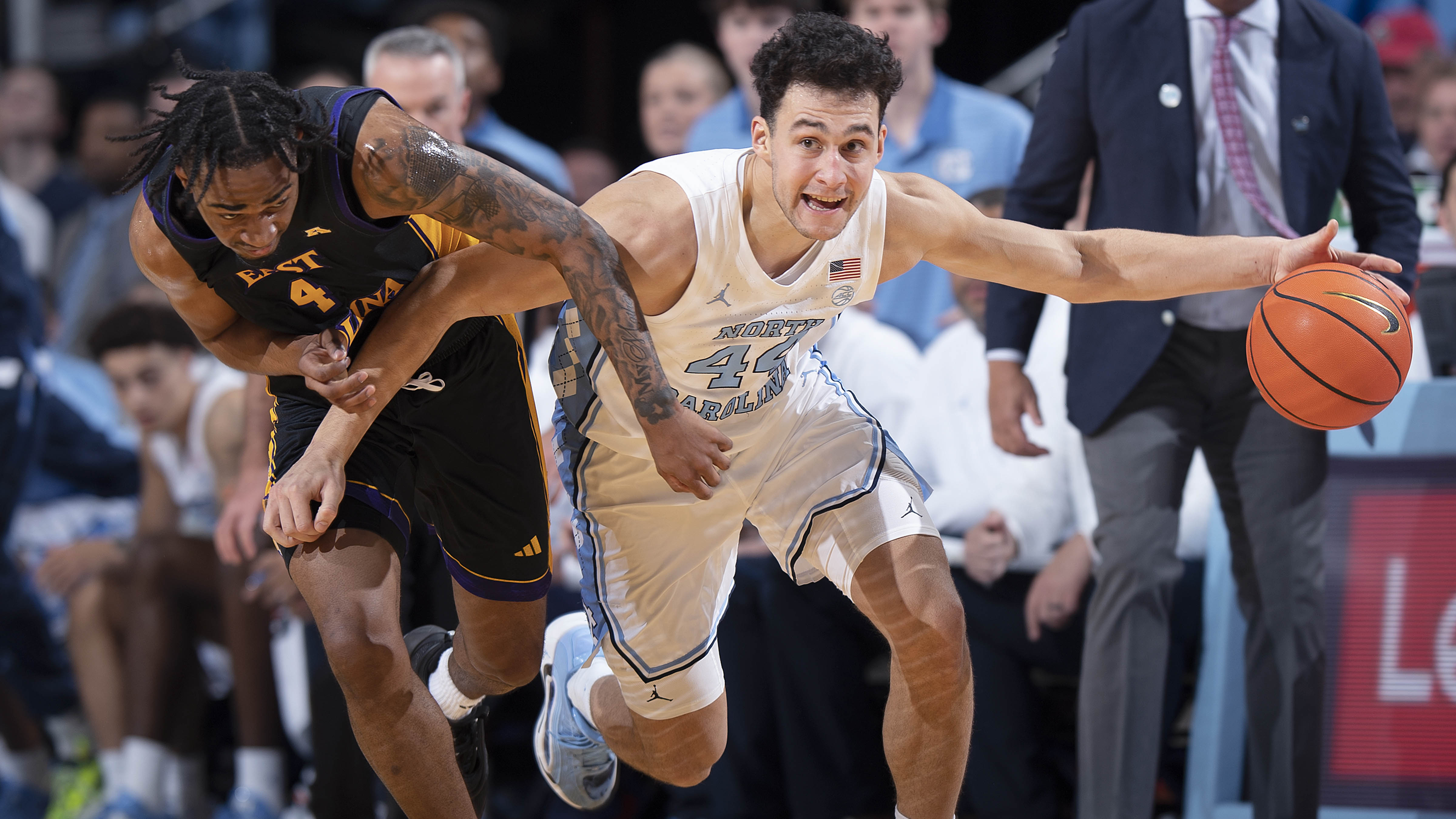
By R.L. Bynum
In the four games since Seth Trimble’s return, North Carolina’s rotation has begun to crystallize.
Trimble, Caleb Wilson and Henri Veesaar are obviously the leaders on both ends of the court. They are the only players who have scored at least 20 points this season for the No. 17 Tar Heels and will determine their ceiling.
Beyond that trio, the next tier is equally clear, but the distribution of minutes is anything but.
Luka Bogavac, Jarin Stevenson, Derek Dixon, Jonathan Powell and Kyan Evans round out the eight-man rotation. The question is how Hubert Davis allocates their time, particularly as point guard play has emerged as a pressing concern.
When asked about his point guard options, Davis has repeatedly emphasized that he doesn’t go by traditional positional labels.
“I’m not a point‑guard/shooting‑guard/small‑forward type of coach,” he said. “I need somebody out there who can check a number of different boxes. I want our guys to do a number of things.”
More on Tar Heels
— Wake Forest at No. 17 UNC: TV info, stats, scouting Deacons, keys to game, comparisons and notes
— Watch, read about best games, biggest individual efforts in Smith Center history
— Davis explains why UNC switching more on defense this season
— ‘It came from every direction’: Davis says UNC’s defensive lapses at SMU need to be ‘one-game thing’
— UNC, other top ACC teams, fall in NET rankings; another game becomes Q1
Since Trimble’s return, Davis has leaned into that flexibility. Those five players allow UNC to adjust its size, pace and best defenders, depending on the matchup. While their averages cluster between 17 and 20 minutes per game, recent trends suggest that specific roles and responsibilities are evolving.
Most notably, Evans has started all four games but is averaging the fewest minutes (17.3 per game) of the group as Davis used Trimble more as his primary initiator in Saturday’s loss at SMU.
“I’ve always wanted multiple ball handlers out there, whether it’s Seth and Ky and Derek [or] all three together,” Davis said. “I’ve used all of them, and even Luka to initiate offense. And so just the execution part of getting to the right spots, getting the ball in the right positions to execute consistently on the offensive end.”
Here’s how Davis has distributed the playing time for those five in the last four games:
Bogavac: The playmaker on the wing
Minutes: 14 vs. OSU → 24 vs. ECU → 13 vs. FSU → 29 at SMU (20.0 per game)
Bogavac’s range of playing time is the widest, but his 29 minutes against SMU (the most since logging a season-high 35 against Michigan State) give him the highest average in the last four games. Although he is far from UNC’s best defender, he showed against the Mustangs the ability to drive and dish rather than forcing a bad (and sometimes wild) driving shot as he has in earlier games. He dished out a season-high six assists against SMU, more than in the previous four games combined (5). He sat on the bench, though, for the last five minutes at SMU.

Stevenson: The trusted frontcourt stabilizer
Minutes: 27 vs. OSU → 16 vs. ECU → 15 vs. FSU → 21 at SMU (19.8 per game)
Stevenson’s usage tracks with UNC’s need for structure and spacing in the frontcourt. He has been the Tar Heels’ backup center since the Ohio State game, when he played 27 minutes. He showed by making 3 of 4 3-point attempts at SMU (after going 6 of 36 for the season before Saturday) and scoring a season-high 16 points that he has the potential to stretch the floor when he’s in at the five as well as Veesaar.
“The versatility and size on both ends of the floor is something that’s unique and special and very important for us,” Davis said, adding that he was high on Stevenson. “There have been times when he found his rhythm, but nothing like against SMU.
“That was really good to see him not only make shots, but be aggressive and be a factor on the offensive end,” Davis said. “He can post up, he can finish and get to the offensive glass. He’s one of our better free-throw shooters, and it was really nice to see him in a rhythm against SMU.”
Dixon: The point guard answer?
Minutes: 24 vs. OSU → 11 vs. ECU → 21 vs. FSU → 17 at SMU (18.3 per game)
The eye test and the numbers suggest that he’s a better option at point guard than Evans. He has 14 assists against only one turnover over the last four games and has no turnovers in the last three games. He’s also a more consistent perimeter shooter for the season (making 40% of his 3-point attempts), although he’s 2 of 10 in the last four games. He played the last five minutes at SMU.
Powell: The game-flow accelerator
Minutes: 15 vs. OSU → 19 vs. ECU → 26 vs. FSU → 11 at SMU (17.7 per game)
Powell’s minutes expand when UNC needs tempo, athletic drive pressure, transition pop and defensive intensity. He provided that in 26 minutes against Florida State, with two 3-pointers, three rebounds, and three assists. He’s the rotation’s spark plug, but he didn’t play for the last 10:52 at SMU.
Evans: The steady guard
15 vs. OSU → 18 vs. ECU → 23 vs. FSU → 13 at SMU (17.3 mpg)
Evans is the dependable connector: he defends and keeps the ball moving. He sometimes disappears and rarely explodes, providing steady usage that patches whatever the rotation needs. He has as many assists as turnovers in the last four games (5), and that’s a big reason lead guard duties have shifted, with Trimble taking the lion’s share in the second half against SMU.
Ultimately, this isn’t a numbers game as much as it is a trust exercise. Davis has a clearer sense of what each player and combination offers, even as it remains fluid, depending on the matchup.
For UNC, the changes from game to game may be less a sign of uncertainty than the coaches still discovering the best lineups with Trimble back in the mix.
Minutes after Wilson, Veesaar and Trimble
| Opponent | Bogavac | Stevenson | Dixon | Powell | Evans |
|---|---|---|---|---|---|
| Ohio St. | 14 | 27 | 24 | 15 | 15 |
| ECU | 24 | 16 | 11 | 19 | 18 |
| FSU | 13 | 15 | 21 | 26 | 23 |
| SMU | 29 | 21 | 17 | 11 | 13 |
| Per game | 20 | 19.8 | 18.3 | 17.4 | 17.3 |

| Date | Month/day | Time | Opponent/event (current ranks) | TV/ record |
|---|---|---|---|---|
| October | ||||
| 24 | Friday | L, 78–76 | vs. No. 9 BYU in SLC | Exhib. |
| 29 | Wednesday | W, 95–53 | vs. Winston-Salem St. | Exhib. |
| November | ||||
| 3 | Monday | W, 94–54 | vs. Central Arkansas | 1–0 |
| 7 | Friday | W, 87–74 | vs. No. 22 Kansas | 2–0 |
| 11 | Tuesday | W, 89–74 | vs. Radford | 3–0 |
| 14 | Friday | W, 97–53 | vs. N.C. Central | 4–0 |
| 18 | Tuesday | W, 73–61 | vs. Navy | 5–0 |
| Fort Myers Tip-Off | ||||
| 25 | Tuesday | W, 85–70 | vs. St. Bonaventure | 6–0 |
| 27 | Thursday | L, 74–58 | vs. No. 12 Michigan State | 6–1 |
| December | ACC/SEC Men’s Challenge | |||
| 2 | Tuesday | W, 67–64 | at Kentucky | 7–1 |
| ————————— | ||||
| 7 | Sunday | W, 81–61 | vs. Georgetown | 8–1 |
| 13 | Saturday | W, 80–62 | vs. USC Upstate | 9–1 |
| 16 | Tuesday | W, 77–58 | vs. ETSU | 10–1 |
| CBS Sports Classic in Atlanta | ||||
| 20 | Saturday | W, 71–70 | vs. Ohio State | 11–1 |
| ————————— | ||||
| 22 | Monday | W, 99–51 | vs. East Carolina | 12–1 |
| 30 | Tuesday | W, 79–66 | vs. Florida State | 13–1, 1–0 ACC |
| January | ||||
| 3 | Saturday | L, 97–83 | at No. 24 SMU | 13–2, 1–1 |
| 10 | Saturday | 6 p.m. | vs. Wake Forest | ACCN |
| 14 | Wednesday | 9 p.m. | at Stanford | ACCN |
| 17 | Saturday | 4 p.m. | at California | ACCN |
| 21 | Wednesday | 7 p.m. | vs. Notre Dame | ESPN2 |
| 24 | Saturday | 2 p.m. | at No. 23 Virginia | ESPN |
| 31 | Saturday | 2 p.m. | at Georgia Tech | ACCN |
| February | ||||
| 2 | Monday | 7 p.m. | vs. Syracuse | ESPN |
| 7 | Saturday | 6:30 | vs. No. 6 Duke | ESPN |
| 10 | Tuesday | 7 p.m. | at Miami | ESPN or ESPN2 |
| 14 | Saturday | 2 p.m. | vs. Pittsburgh | ESPN |
| 17 | Tuesday | 7 p.m. | at N.C. State | ESPN or ESPN2 |
| 21 | Saturday | 1 p.m. | at Syracuse | ABC |
| 23 | Monday | 7 p.m. | vs. No. 20 Louisville | ESPN |
| 28 | Saturday | 6:30 or 8:30 | vs. Virginia Tech | ESPN or ESPN2 |
| March | ||||
| 3 | Tuesday | 7 p.m. | vs. Clemson | ESPN or ESPN2 |
| 7 | Saturday | 6:30 | at No. 6 Duke | ESPN |
| 10–14 | Tues.-Sat. | ACC tournament | Spectrum Center, Charlotte |
Photo courtesy of UNC Athletics

 tarheeltribune.com
3 Comments