

By R.L. Bynum
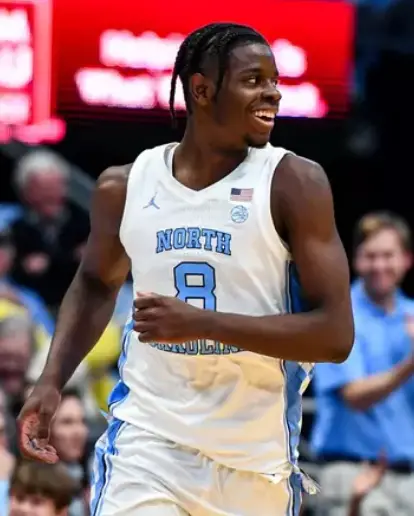
CHAPEL HILL — Caleb Wilson knows that his Carolina career will be over after his only experience with March Madness, and he didn’t like how the last couple of weeks went.
“For me, honestly, I just know that my time here is limited, and I want to make the most of it,” he said. “So, every game matters to me.”
Part of that is much more than the flashy dunks and the prolific numbers. It’s about becoming a leader even though he’s a freshman, in significant contrast to when Coach Hubert Davis was a freshman and barely said anything in his first season.
Wilson said the realization hit him on the long flight back from California after a frustrating trip to the Bay Area.
“I just thought I had to be more of a leader,” Wilson said. “I just felt like I had to take more pride in what I was doing.”
More on Tar Heels
— Davis says good practices led to turnaround defensively and in all areas
— Smith Center debate is Carolina’s identity crisis
— Roy Williams passionately urges UNC to renovate Smith Center, cites Dean Smith’s wishes
— ESPN says ‘technical issue’ led fans to miss large chunk of UNC-Cal game
Wilson scored a game-high 22 points, pulled down seven rebounds and led No. 22 North Carolina with five assists in a 91–69 victory Wednesday at the Smith Center over Notre Dame. He also made sure his teammates matched his intensity, something Davis said has only emerged recently.
Davis said that Wilson has stepped up dramatically with his leadership.
“The last couple of days, including tonight, he’s one of the guys who was more vocal in practice, more vocal right before we went out for warm-ups for the game,” Davis said. “I said my last words before we went out to the floor. He said, ‘Coach, can I say something?’ And he went after the team. He said, “Look, let’s go out there and compete.’ He’s never done that before, and so I really liked that from him.”
The shift stood out to Davis in part because the program’s leadership structure was so different when he played.
“We spent some time together last couple of days in my office, and it’s different,” Davis said. “Now, when I was in school, I think maybe I said one word in my freshman year. Everything was built on seniority. Everything’s different now.”
Davis emphasized that modern college basketball doesn’t allow for waiting your turn, whether you are a freshman, a walk-on, a starter or a player who doesn’t get any minutes.
“I want guys to speak up. I want guys to be leaders,” he said. “And I’ve enjoyed Caleb being more vocal the last three days. I think it’s really ignited our team.”
That urgency showed itself defensively, where North Carolina clamped down in the second half after Notre Dame made six of 12 first-half 3-point attempts but only 2 of 13 after halftime.
“We just stuck to shooters; [that] probably was the biggest thing,” Wilson said. “We communicated. Talked loud; it was a lot of communication out there. We were physical and didn’t let the other team impose their will on us.”
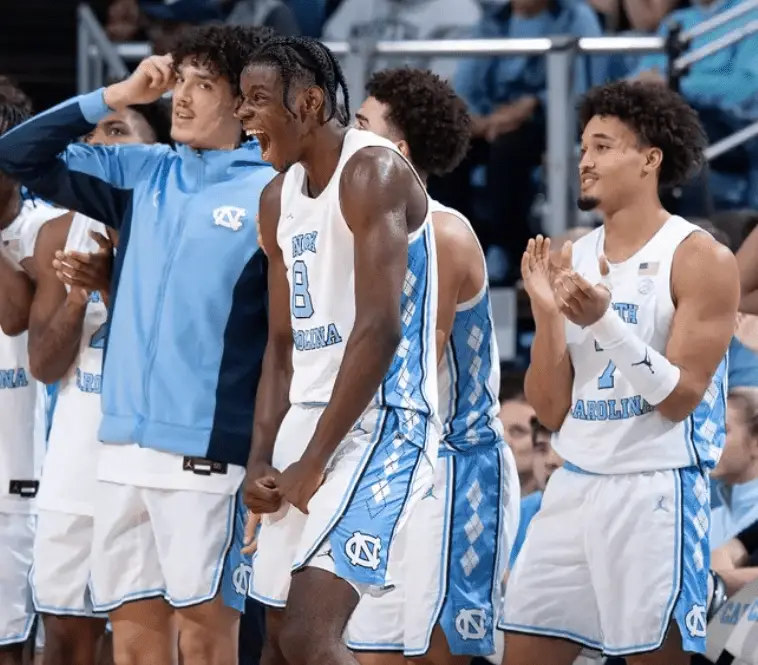
Davis echoed that point, noting that communication — not scheme — was the biggest adjustment after halftime.
“The communication at times wasn’t there in the first half,” Davis said. “And I thought they did a much better job, especially when we went to our quote, unquote, small lineup, where Caleb was at the five. We did a much better job of communicating in the second half.”
The improved communication was part of a broader response to what Davis described as a wake-up call.
“There were multiple possessions where we were making mistakes — in back-to-back possessions,” Davis said of the losses at Stanford and Cal. “And I felt like last week we were letting one play affect us on the other end to the next play.”
Wilson took that message personally, especially after reviewing the game video.
“I figured out so much stuff that I was doing and my teammates were doing that was just prohibiting us from winning,” he said. “Defense rotations, not going to offensive glass, not sacrificing yourself for your teammates by screening and stuff like that. Once we were able to focus on that and really get that in our heads, it really just changed our mentality and our mindset for you in some of the coming games.”
Offensively, Wilson showed growth as well, consistently passing out of double teams and finding shooters during a night when Carolina made 13 threes, with eight players connecting from outside the arc.
“You work on it in practice,” Wilson said. “Most teams are gonna know me from here on out. So, I just expect that; I know where it’s coming from. I know what to do to get out of it, and I also know where my teammates will be, so it just makes it much easier to just make a read.”
His approach has also become more internal since he decided to ignore what people are saying about him on social media.
“I’ve actually stopped trying to look at my phone and try to focus on myself,” Wilson said. “I was out to prove everyone wrong, and it’s kind of changed for me. I try to prove myself right now, every game I go out. I just have fun and try to play, because eventually everybody is gonna be on your side if you win. That’s how it is.”
All of it unfolded on a stage Wilson still finds awe-inspiring.
“When I’m driving to practice or something like that, when I’m up on the hill, and you look down to see the Smith Center? It’s just like, dang, that’s where I’m going to be playing,” Wilson said. “It’s just kind of really cool.”
On this night, Wilson didn’t just play on that stage. He owned it, vocally and visibly, in a way that may define his short but impactful time in Chapel Hill.
Photos courtesy of UNC Athletics

 tarheeltribune.com
2 Comments