

By R.L. Bynum
North Carolina’s recent defensive growth hasn’t been about reinventing the Tar Heels’ approach but making adjustments.
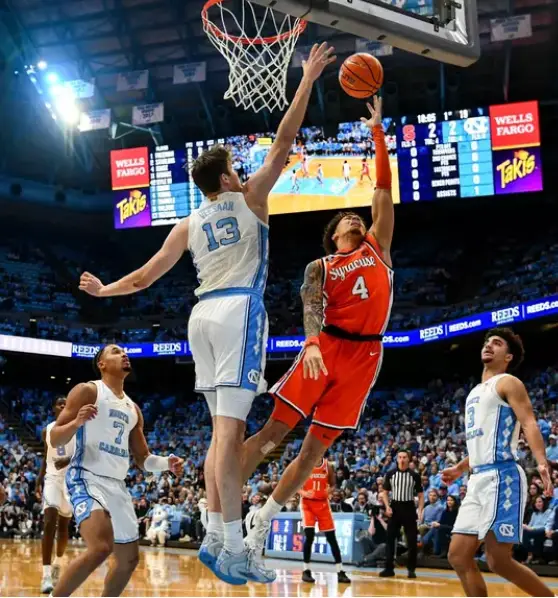
After some recurring struggles for much of the season, especially with giving up too many open shots from outside the arc, No. 14 UNC (18–4, 6–3 ACC) has made clear strides in how it defends ball screens during its four-game win streak.
The shift has been subtle but meaningful: more discipline, more trust and a stronger commitment to drop coverage that keeps shooters from getting loose on the perimeter.
On the “Hubert Davis Live” radio show on Wednesday, Assistant coach Marcus Paige, sitting in for Davis, pointed to that adjustment as one of the biggest defensive storylines since the team’s rocky California trip.
“Defense has been the big topic for us,” Paige said ahead of the Tar Heels’ 6:30 Saturday matchup (ESPN) with No. 4 Duke (21–1, 10–0). “We’ve made some scheme adjustments, trying to keep the pick-and-rolls more two-on-two. We see less helping, less allowing threes, and more making guards play in the paint against our length.”
That’s the trade-off of drop coverage. Instead of overcommitting help defenders and giving up kick-out 3s, Carolina is asking Henri Veesaar to patrol the paint while perimeter players stay connected to shooters.
It may concede the occasional midrange shot or layup, but it limits the backbreaking 3-point barrages that had hurt them in so many games. Paige acknowledged that reality.
“Our drop coverage was better,” Paige said. “That’s going to leave you susceptible to some baskets, and you’re going to give up a layup or two. That’s a trade-off that we were willing to concede given how many threes we’ve been giving up.”
After giving up at least 20 3-point attempts in the previous 12 games, Georgia Tech attempted only 13, and Syracuse attempted only 18. Opponents scored double-digit 3-pointers in five consecutive games before the Tar Heels gave up eight or fewer in the last four.
Syracuse only scored six 3-pointers Monday, the fewest allowed in ACC play, with half of those during the Orange’s crazy flurry in the final 10 minutes of UNC’s 87–77 victory. Opponents have made 35% of their 3-point attempts in the last four games after they made 50% in the four games before that.
At the center of that improvement is Veesaar, whose presence inside has allowed guards to defend with more confidence outside. The more they trust him to clean up drives, the less they feel the need to collapse inward. That makes it easier to close out on shooters.
Veesaar sees the difference clearly.
“Yeah, I think so, for sure, because we have to be less pulled in,” Veesaar said after Monday’s victory over Syracuse. “And I feel like the guards are starting to trust me to protect the rim on the drives.”
That trust is the foundation of the scheme. Carolina’s guards can fight over screens and stay attached, knowing their big man is waiting behind them instead of panicking into overhelp.
Veesaar understands that drop coverage isn’t perfect and that teams will still score at the rim sometimes.
“If you give a couple layups or so, it happens every game,” he said. “But overall, if you can take away the 3-point attempts, it really helps us in the long run.”
The Tar Heels’ defensive progress hasn’t just been about X’s and O’s. It’s also been about sustaining focus for a full 40 minutes, something Paige said has been emphasized repeatedly.
“Coach Davis talks a lot about chasing a full 40 minutes,” Paige said. “Sometimes when you flip the switch off, it’s hard to turn it back on.”
That consistency is still the next step after failing to do it on Monday night. But the upward trend is real. Carolina’s pick-and-roll coverage is tighter, the rotations are cleaner and the perimeter defense is benefiting from having a reliable anchor inside.
Now, with the Heels defending ball screens with more discipline and closing out harder on shooters, the blueprint is starting to show results: fewer open 3-point attempts, more controlled possessions, and a defense that’s steadily catching up to Carolina’s already potent offense.

| Team | League | Overall | NET* |
|---|---|---|---|
| No. 4 Duke | 10–0 | 21–1 | 2 |
| No. 20 Clemson | 9–1 | 19–4 | 31 |
| No. 18 Virginia | 8–2 | 19–3 | 16 |
| N.C. State | 8–2 | 17–6 | 25 |
| No. 14 North Carolina | 6–3 | 18–4 | 27 |
| Miami | 6–3 | 17–5 | 37 |
| No. 24 Louisville | 6–4 | 16–6 | 18 |
| California | 5–5 | 17–6 | 55 |
| Virginia Tech | 5–5 | 16–7 | 57 |
| SMU | 4–5 | 15–7 | 34 |
| Syracuse | 4–6 | 13–10 | 69 |
| Florida State | 3–6 | 10–12 | 100 |
| Stanford | 3–7 | 14–9 | 77 |
| Wake Forest | 2–7 | 11–11 | 70 |
| Boston College | 2–7 | 9–13 | 149 |
| Pittsburgh | 2–7 | 9–13 | 113 |
| Georgia Tech | 2–8 | 11–12 | 143 |
| Notre Dame | 2–8 | 11–12 | 86 |
* — Through Wednesday games
Wednesday’s results
No. 24 Louisville 76, Notre Dame 65
California 90, Georgia Tech 85
No. 20 Clemson 66, Stanford 64
Saturday’s games
Virginia Tech at N.C. State, noon, The CW
Syracuse at No. 18 Virginia, noon, ESPN
No. 24 Louisville at Wake Forest, noon, ACC Network
Miami at Boston College, 2 p.m., ACC Network
SMU at Pittsburgh, 2 p.m., The CW
Florida State at Notre Dame, 4 p.m., The CW
No. 4 Duke at No. 14 North Carolina, 6:30, ESPN
No. 20 Clemson at California, 8 p.m., ACC Network
Georgia Tech at Stanford, 8 p.m., ESPNU
Monday’s game
N.C. State at No. 24 Louisville, 7 p.m., ESPN
Tuesday’s games
No. 14 North Carolina at Miami, 7 p.m., ESPN
No. 18 Virginia at Florida State, 7 p.m., ESPNU
Notre Dame at SMU, 7 p.m., ACC Network
No. 4 Duke at Pittsburgh, 9 p.m., ESPN
Wednesday, Feb. 11, games
Virginia Tech at No. 20 Clemson, ACC Network
California at Syracuse, 7 p.m., ESPNU
Wake Forest at Georgia Tech, 9 p.m., ACC Network
Stanford at Boston College, 9 p.m., ESPNU
Photo courtesy of UNC Athletics

 tarheeltribune.com