

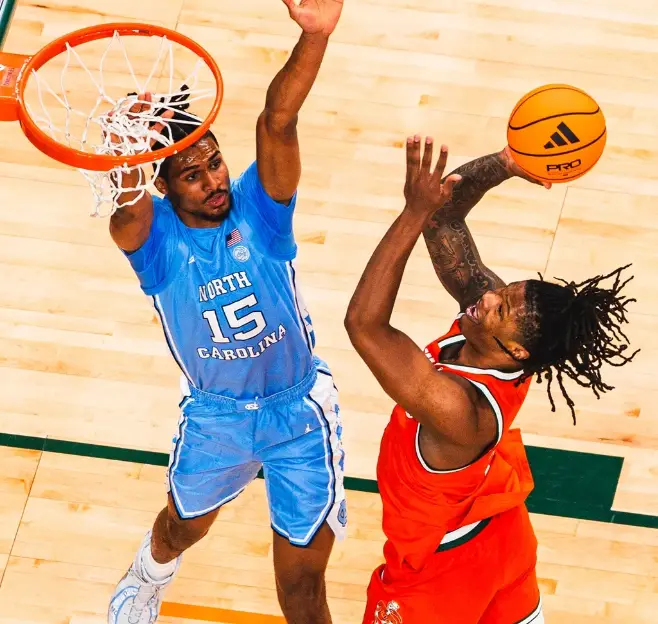
By R.L. Bynum
CORAL GABLES, Fla. — Slow starts have become a troubling trend that North Carolina can’t shake. The Tar Heels have been a good second-half team most of the season, but couldn’t find the rhythm Monday against Miami.
Carolina fell to 5–5 in Quad 1 games after its 75–66 loss at Miami. The Tar Heels trailed after five minutes in all but one (at Stanford) and faced halftime deficits in all but three (Ohio State, SMU and Stanford).
The lack of intensity and focus early in games is a persistent problem that the Tar Heels will have to fix, and they certainly couldn’t solve the Hurricanes’ mixing of man-to-man and zone.
Turnovers piled up early, and center Henri Veesaar called that start “kind of unacceptable.”
“We just kind of started, maybe a little loose at the start of the game, where we turned the ball over a lot,” he said. “We’ve got to do a better job of [starting games well].”
The toughness plays, the rebounds, the 50-50 balls, the disciplined possessions tilted the game early. Miami controlled the paint and made UNC pay for defensive lapses and repeatedly failing to block out under the boards.
“What needed to work was rebounding and making those toughness plays,” UNC coach Hubert Davis said. “It’s not about missed shots. It’s about defense, rebounding and taking care of the basketball, and those are the boxes that we didn’t definitively check today.”
North Carolina stayed within striking distance at halftime despite Miami shooting 58% in the first half, but the Tar Heels never found the consistent force they needed inside. Miami finished with 46 points in the paint, repeatedly driving free to the basket or creating second chances.
Jarin Stevenson pointed to breakdowns around the rim as the root of the problem.
“Got to defend better in the paint,” Stevenson said. “A lot of that comes from messing up our switches or just offensive rebounds. So just working on that, boxing out.”
UNC’s offense also stalled in the second half, when the Tar Heels shot just 26% from the floor. Davis said UNC simply settled instead of attacking.
“They went back to man and zone. I felt like we settled instead of getting the ball [inside],” Davis said, lamenting that his team didn’t get to the free-throw line enough. “How you get to the free throw line is shots towards the basket, and we just couldn’t generate and find consistency to be able to do that, whether it was from our bigs or our guards attacking a basket.”
Stevenson said the struggles weren’t just about missing shots, but about confidence and decisiveness.
“I think it’s just us being confident in what we have,” he said. “I feel like there are some opportunities where we could just go in and make a play. I think we’ve got to be confident in that. There were good play calls. We missed some bunnies, I feel like, too.”
Veesaar echoed that Miami didn’t necessarily do anything unexpected — the issue was UNC’s execution and aggressiveness from the opening minutes.
“I feel like we’re trying to have a plan, but just to play our play,” Veesaar said. “I wouldn’t say there’s anything on the coaches more on the players. We just didn’t have the aggressiveness and the ball pressure that we needed to have.”
Miami’s physicality also showed up on the boards and in the paint, where UNC couldn’t consistently finish possessions.
“They got great size down there,” Veesaar said. “So, they did a really good job of using their size and did a good job of limiting us under the boards.”
Kyan Evans said UNC was prepared for the defensive switching between zone and man, but still struggled to flow offensively.
“Miami played a lot of different defenses,” Evans said. “So, it was different to get into the flow of the game.”
For Davis, the bigger concern wasn’t the offense’s rhythm as much as the consistent issues that keep showing up.
“Shots go in, shots … sometimes you make them, sometimes you don’t,” he said. “Stuff that shows up every day, and that’s defense, rebounding and taking care of the basketball.”
Until North Carolina solves its slow-start problem and matches opponents’ physicality from the opening tip, those boxes will remain unchecked — and Quad 1 opportunities will keep slipping away.

| Date | Month/day | Time | Opponent/event (current ranks) | TV/ record |
|---|---|---|---|---|
| October | ||||
| 24 | Friday | L, 78–76 | vs. No. 22 BYU in SLC | Exhib. |
| 29 | Wednesday | W, 95–53 | vs. Winston-Salem St. | Exhib. |
| November | ||||
| 3 | Monday | W, 94–54 | vs. Central Arkansas | 1–0 |
| 7 | Friday | W, 87–74 | vs. No. 9 Kansas | 2–0 |
| 11 | Tuesday | W, 89–74 | vs. Radford | 3–0 |
| 14 | Friday | W, 97–53 | vs. N.C. Central | 4–0 |
| 18 | Tuesday | W, 73–61 | vs. Navy | 5–0 |
| Fort Myers Tip-Off | ||||
| 25 | Tuesday | W, 85–70 | vs. St. Bonaventure | 6–0 |
| 27 | Thursday | L, 74–58 | vs. No. 10 Michigan State | 6–1 |
| December | ACC/SEC Men’s Challenge | |||
| 2 | Tuesday | W, 67–64 | at No. 25 Kentucky | 7–1 |
| ————————— | ||||
| 7 | Sunday | W, 81–61 | vs. Georgetown | 8–1 |
| 13 | Saturday | W, 80–62 | vs. USC Upstate | 9–1 |
| 16 | Tuesday | W, 77–58 | vs. ETSU | 10–1 |
| CBS Sports Classic in Atlanta | ||||
| 20 | Saturday | W, 71–70 | vs. Ohio State | 11–1 |
| ————————— | ||||
| 22 | Monday | W, 99–51 | vs. East Carolina | 12–1 |
| 30 | Tuesday | W, 79–66 | vs. Florida State | 13–1, 1–0 ACC |
| January | ||||
| 3 | Saturday | L, 97–83 | at SMU | 13–2, 1–1 |
| 10 | Saturday | W, 87–84 | vs. Wake Forest | 14–2, 2–1 |
| 14 | Wednesday | L, 95–90 | at Stanford | 14–3, 2–2 |
| 17 | Saturday | L, 84–78 | at California | 14–4, 2–3 |
| 21 | Wednesday | W, 91–69 | vs. Notre Dame | 15–4, 3–3 |
| 24 | Saturday | W, 85–80 | at No. 15 Virginia | 16–4, 4–3 |
| 31 | Saturday | W, 91–75 | at Georgia Tech | 17–4, 5–3 |
| February | ||||
| 2 | Monday | W, 87–77 | vs. Syracuse | 18–4, 6–3 |
| 7 | Saturday | W, 71–68 | vs. No. 4 Duke | 19–4, 7–3 |
| 10 | Tuesday | L, 75–66 | at Miami | 19–5, 7–4 |
| 14 | Saturday | 2 p.m. | vs. Pittsburgh | ESPN |
| 17 | Tuesday | 7 p.m. | at N.C. State | ESPN |
| 21 | Saturday | 1 p.m. | at Syracuse | ABC |
| 23 | Monday | 7 p.m. | vs. No. 24 Louisville | ESPN |
| 28 | Saturday | 6:30 or 8:30 | vs. Virginia Tech | ESPN or ESPN2 |
| March | ||||
| 3 | Tuesday | 7 p.m. | vs. No. 20 Clemson | ESPN or ESPN2 |
| 7 | Saturday | 6:30 | at No. 4 Duke | ESPN |
| 10–14 | Tues.-Sat. | ACC tournament | Spectrum Center, Charlotte |
Photo via miamihurricanes.com

 tarheeltribune.com